

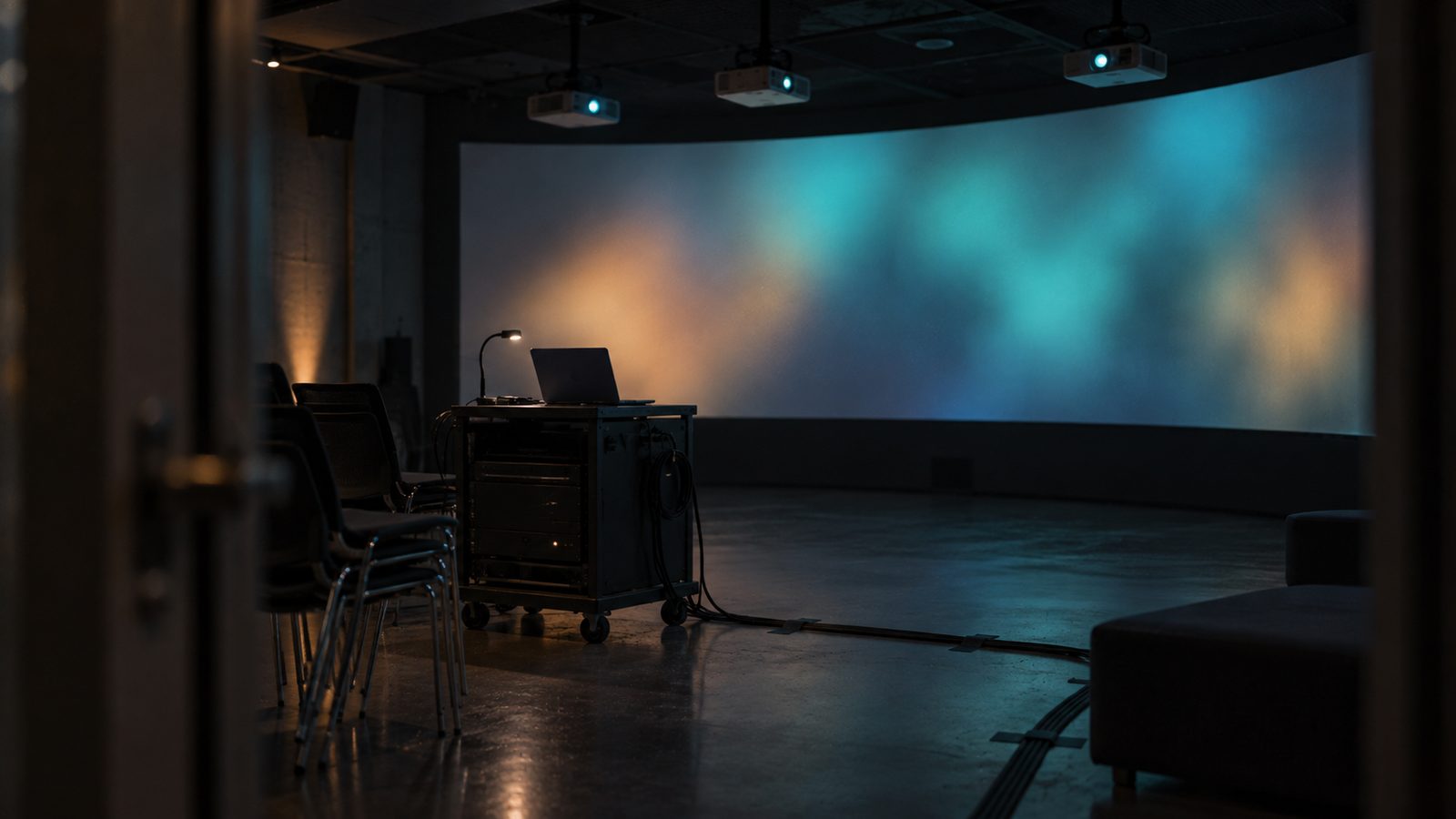
Most immersive rooms in the UK were bought before anyone decided what would run on them. The hardware is straightforward to procure and the content is not, which is why so many of these rooms end up cycling the same rainforest video eighteen months after the ribbon was cut. The fix is not a bigger content pack. It is realising that a projection room shows a wide horizontal band, often around 10:1, and that almost nothing made for a 16:9 screen survives contact with it.
Key takeaway: Your room is not a big television. It is a band of pixels wrapped around a group of people, and the content that works is content built for that shape, about your subject, by you. The best independent evidence says outcomes depend on how many people are in the room, not on how much content you licensed.
The shape of the problem
A real, published example. The University of Queensland’s Igloo cylinder is six metres across and two metres high, seats up to twelve people, and runs at a total resolution of 12508 × 1200 (UQ Advanced Data Practices). That is an aspect ratio of about 10.4:1.
A worked six-projector room specification from calibration software vendor VIOSO gives similar numbers for a three-sided space: projectors at 1920 × 1200 each, a combined wall canvas of 8640 × 1200, and a separate floor canvas of 2160 × 1728 once a 10% overlap is accounted for (VIOSO immersive rooms workflow).
Two things follow from that, and they catch out nearly every first content project:
- Walls and floor are different content. VIOSO puts it plainly: this “leads typically to at least two different contents: one content for the walls and a different content for floor.” A single canvas does not stretch neatly around a corner and down onto the ground.
- You do not author the warp. Edge blending and geometric warping are done in the GPU or the media server, using tools like Christie Twist and Mystique. You supply a flat wide image or video per surface and the room distorts it. Authors who try to pre-distort their own content make more work and worse results.
Drop a 1920 × 1080 video into a 12508 × 1200 canvas and it occupies roughly 15% of the width. It will look like a postage stamp with two very expensive projectors displaying black either side of it.
Resolution: less than the marketing suggests
Equirectangular content is a strict 2:1 ratio, a sphere unwrapped into a flat map. Igloo’s own documentation lists the common working resolutions as 3840 × 1920, 4096 × 2048, 5760 × 2880 and 7680 × 3840 (Igloo docs).
Before you go chasing 8K, look at what a room actually consumes. A two-metre-high band of a six-metre cylinder is 1200 pixels tall in the UQ example. ThingLink’s own published guide for driving an Igloo tells users to set the browser view to 6000 × 1000 (ThingLink support).
A projection room generally needs less raw equirectangular resolution than a headset does, because the viewer sits metres from the screen and sees a horizontal band rather than the full sphere at close range. 4K to 6K equirectangular is realistic. 8K is a ceiling, not a requirement, and chasing it mostly costs you GPU memory. Igloo’s own documentation warns that the larger the canvas resolution, the more GPU memory is needed.
Who actually sells authoring, and who does not
This is the part buyers discover after the install, so it is worth setting out plainly.
| Supplier | What they sell | Own authoring tool |
|---|---|---|
| Igloo Vision | Cylinders, cubes, domes, CAVEs from 180° to 270°, plus the Igloo Core Engine | No, deliberately content-agnostic |
| Immersive Interactive | Room design and install, content library, Immersive Studio | Yes |
| Gener8 | Room build and software licensing | No, built on Intuiface |
| Pufferfish | Spherical and hemispherical displays | Yes, for spheres |
| AmbiSpace, I-Immersive, BT, ClassView | Room build and integration | No |
| ClassVR / Avantis | VR headsets and portal | Not a room supplier at all |
Igloo is the biggest name in the category and it does not sell an authoring tool by choice. Its education blog says so: the room displays “almost any web-based application” through a built-in WebViewer, alongside Unreal, Unity, Matterport, Office, Teams, Miro and free sources like SketchFab and Google Street View (Igloo Vision).
That is a reasonable position for a display company. It also means that if you buy the most prestigious room on the market, authoring is your problem, and the vendor is politely telling you so up front.
What the evidence actually says about outcomes
Independent research on immersive rooms specifically is thin, and the best controlled study points somewhere nobody expects.
De Back, Tinga and Louwerse ran 147 participants through a four-wall CAVE at Tilburg University and measured normalised learning gains by group size. Solo use produced a mean gain of 0.430, groups of two to four 0.307, groups of five to six 0.269, with a significant main effect of group size, F(2,138)=6.41, p=0.002. When in the course the session happened made no measurable difference at all (International Journal of Educational Technology in Higher Education, 2021).
So the thing that most changes what your room delivers is the timetable, not the content budget. Book two to four people at a time. A room running class-size groups of thirty is doing something valuable, but it is not the thing that study measured.
The one published UK implementation study of an immersive room in healthcare education, from the University of Hertfordshire team via ASPiH, is small and uncontrolled but has a content finding worth pinning to the wall: long videos and long text caused engagement to drop, and the team had to shorten videos and add more activity across four iterations (Journal of Healthcare Simulation, November 2025).
It is also worth saying what is absent. We looked through the published case studies from the main room vendors and found no quantified learning outcomes in any of them. Plenty of testimonials, no numbers. Treat that as useful information when a supplier’s case study is the evidence being offered.
A content pattern that works
Based on what holds attention in a room rather than on a desk:
- Wide by design. Author to the room’s canvas ratio, not to 16:9. A panorama of a real place beats a video of anything.
- Short segments, then a decision. Under two minutes of playback, then something the group has to answer or choose.
- One focal point, positioned deliberately. In a 270° space, people are looking at roughly a third of the room at any moment. Put the thing that matters where the group is facing.
- Real places over stock. A 360° capture of your own ward, workshop or site outperforms a licensed environment, for the same reason a photograph of your street is more interesting than a photograph of a street.
- The same build everywhere. A scenario authored once should run on the wall for group teaching, in a headset for individual practice, and in a browser for the learners who cannot get into the room that week.
That last point is the one most rooms lack. In Node XR, wall scenes and headset scenes are the same project, with hotspot groups keyed per screen slot, so the wall version is a publishing target rather than a separate production. BD used an immersive wall build for exhibition stands and measured roughly three times the dwell time of a conventional stand.
What rooms cost, since nobody publishes it
UK public sector procurement notices do, which is a useful antidote to quote-only pricing:
| Buyer | Supplier | Value, ex VAT | Scope |
|---|---|---|---|
| Tameside College | Igloo Vision | £463,334 | 270° or 360° projection including floor |
| Wrexham University | Open tender | £385,000 | Four-wall and floor projection suite |
| Westminster City Council (WAES) | BT | £140,520.86 | Single immersive classroom, hardware and software |
Sources: Find a Tender 034277-2023, 034365-2024, 002770-2025. Wrexham is worth noting twice: the same buyer tendered at £250,000 in May 2024 and £385,000 in November 2024.
Against a six-figure room, the content question is not whether authoring is worth paying for. It is whether you want to keep paying someone else every year for content about somewhere that is not your building.
The short answer
Immersive room content works when it is built for the room’s real shape, kept short, broken up with decisions, and made about a place your learners recognise. Author it yourself, supply flat wide media per surface and let the room handle the warping, and schedule small groups if learning outcomes are what you are measuring.
More on how wall scenes are built and published on the immersive walls page, and the immersive wall glossary entry covers the terminology procurement will use.