

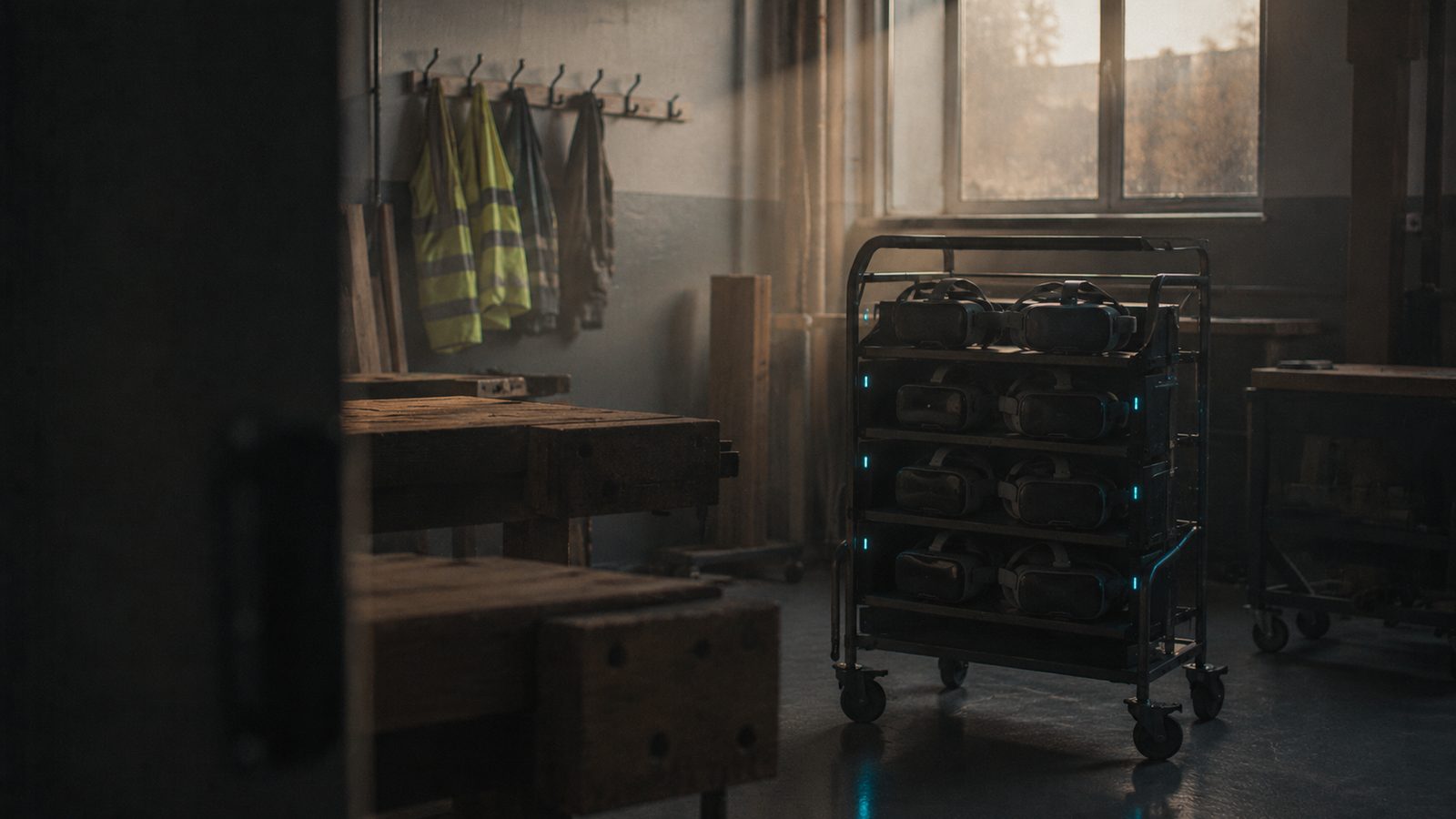
UK colleges no longer need an agency, a developer, or a media budget to run VR training. With a no-code platform, curriculum staff build immersive scenarios themselves — filmed in their own workshops and salons — and deploy them to the headsets the college already owns, plus browsers, tablets and phones. ACT Training Wales and Merthyr Tydfil College both went from concept to live scenarios with their existing staff; Merthyr’s construction safety induction took under three weeks from concept to live.
Key takeaway: Vocational training is local — the hazards in your salon, the layout of your site. That’s why agencies and generic libraries keep disappointing colleges, and why the build-it-yourself route wins: the person who knows the workshop builds the scenario.
The problem with how colleges bought VR until now
Most college VR projects went one of two ways. Either a bespoke agency built a beautiful scenario for a five-figure sum that could never be edited again — or the college bought an off-the-shelf library whose generic content didn’t match the awarding-body spec, the college’s equipment, or the workshops learners would actually walk into.
Both routes fail the same test: vocational training is local. The hazards in your salon, the layout of your site, the machines in your workshop.
What “build your own” actually looks like
- Capture your environment. A 360° camera walk-through of the salon, workshop or site — or generate scenes from a text prompt with AI if you can’t film. (What you can build.)
- Layer interactions, no code. Hotspots, branching decisions, multiple choice, drag-and-drop, dialogue. If staff can use PowerPoint or Canva, they can build a scenario.
- Publish everywhere at once. One build runs on Meta Quest, desktop browsers, phones, tablets — and immersive walls if your college has an immersive room.
- Track everything. Every learner decision and score, exportable to your LMS via SCORM or xAPI (integrations).
What results look like
ACT Training Wales — the country’s largest apprenticeship provider — built a hair & beauty salon safety scenario where apprentices spot every hazard before stepping into a real salon, recording a 45% improvement in hazard identification accuracy against baseline (2025 apprentice cohort). At Merthyr Tydfil College, apprentices complete a full construction safety induction — walking the site, spotting hazards — before touching real scaffolding, and tutors report students arriving on placement more confident and prepared.
Pre-induction: the quickest win
If you build one scenario this term, make it a workshop pre-induction. Every learner completes it before their first practical session: hazards spotted, kit identified, rules demonstrated — evidenced automatically, repeatable for every cohort at no extra cost.
The short answer
UK colleges can build their own VR training with existing staff, no code and no agency: capture the environment in 360° (or generate it with AI), layer decisions and assessment on top, publish to the devices learners already use, and evidence everything automatically. ACT Training and Merthyr Tydfil College both shipped scenarios this way — the constraint isn’t technical skill, it’s knowing the workshop, and your staff already have that.
Getting started without a budget line
The free tier lets curriculum staff build and share a full scenario — 2D and 360° images, every hotspot type, AI-assisted generation — before anyone signs anything. When you’re ready to scale, talk to us or book a demo and we’ll build a scenario for your curriculum area during the call.