

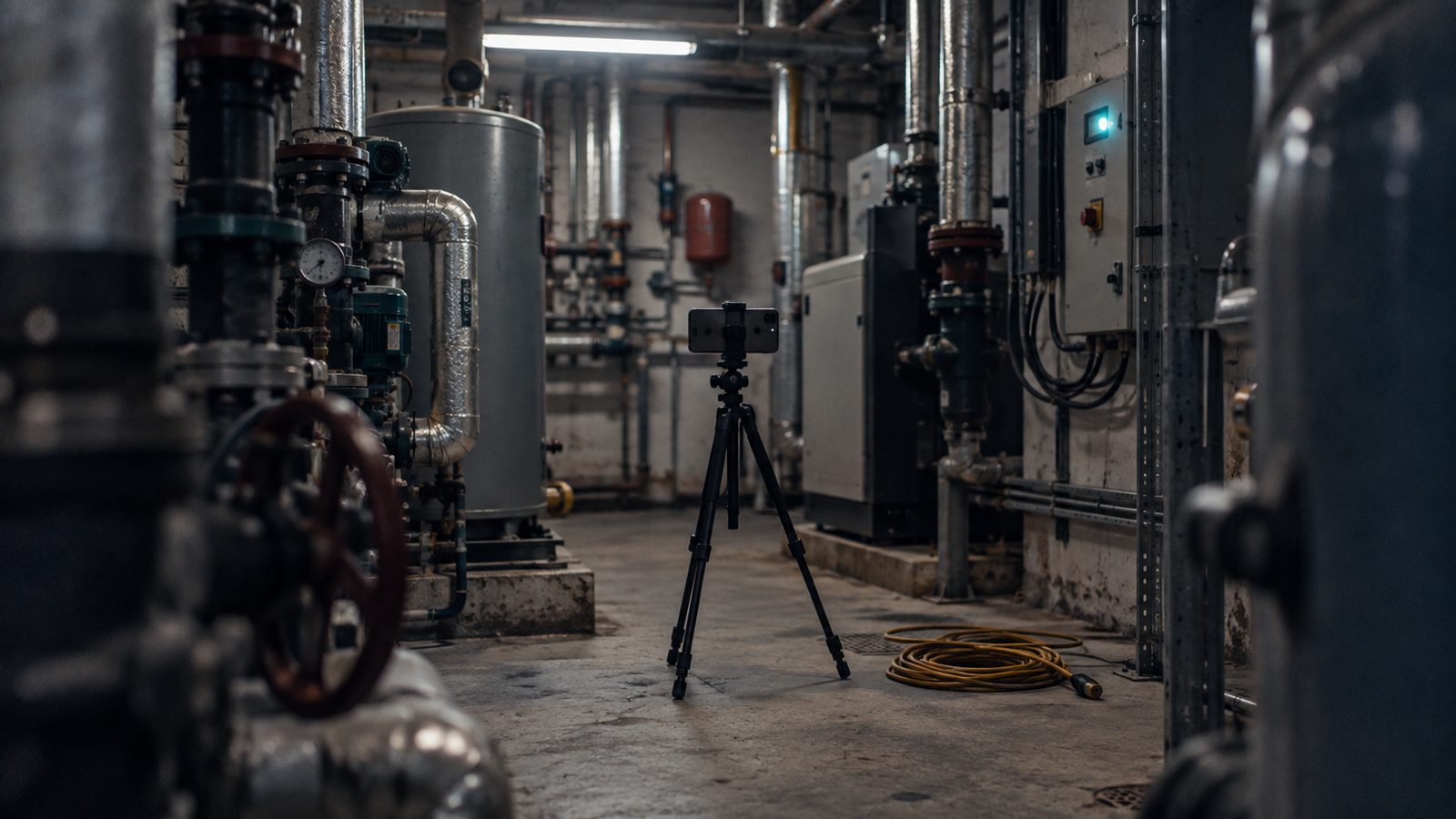
A Gaussian splat is a 3D capture of a real place made from ordinary photographs, which you can then walk around inside a browser. It is not a 3D model in the usual sense, because there are no surfaces, just millions of small fuzzy coloured blobs arranged in space. For training, it does one thing better than anything else and several things worse, and knowing which is which will save you a wasted fortnight.
Key takeaway: Splats buy you presence and freedom of movement. They cost you legible text, editable lighting and file size. Capture a plant room so people can find their way around it, not a control panel so people can read the gauges.
What a splat actually is
Take a photograph of a room from a hundred angles. Software works out where the camera was for each shot, then fills the space with tiny translucent ellipsoids until the whole collection, viewed from any of those angles, looks like the photographs.
Each of those ellipsoids carries a position, a rotation, a scale, an opacity and a colour. The Khronos specification for the format lists exactly that: splats are defined “by their position, rotation, scale, opacity, and spherical harmonics, which provide both diffuse and specular color” (Khronos). The spherical harmonics part is why a splat capture looks convincingly glossy: the colour of a blob changes depending on where you look at it from, so wet floors and polished metal behave roughly as they should.
The technique comes from a 2023 paper by Bernhard Kerbl, Georgios Kopanas, Thomas Leimkühler and George Drettakis, published in ACM Transactions on Graphics (project page). Their measured results ran from 134 to 197 frames per second across the test scenes, with training taking about 26 to 42 minutes on an NVIDIA A6000 to reach full quality. The scenes used between one and five million splats.
The reason it is fast is worth one sentence, because it explains the whole trade. A NeRF, the technique splats replaced, asks a neural network what colour to paint at millions of points along millions of rays. A splat scene is just a pile of objects that get sorted by depth and drawn, which graphics cards have been doing since the 1990s.
What it costs you
Speed is bought with disk space. The original paper’s trained scenes ran from 411MB to 734MB, against 8.6MB for the neural model it was compared with. A standard PLY file carries 59 floating point numbers per splat, roughly 236 bytes each, so a million-splat capture lands somewhere near 236MB before compression (PlayCanvas).
Compression has moved quickly. Niantic’s SPZ format is open source under MIT and produces files “typically around 10x smaller than the corresponding .ply files, with minimal visual differences” (Niantic). Self-organising Gaussians go further: PlayCanvas reported a 1GB file of four million splats compressed to 55MB (PlayCanvas).
There is also, finally, a standard on the way. Khronos announced KHR_gaussian_splatting as a glTF release candidate on 3 February 2026, with ratification expected in the second quarter, backed by Autodesk, Esri, Niantic Spatial, NVIDIA, Huawei and Cesium (Khronos). Until that lands, expect to convert between formats.
Capturing one without a workstation
The research pipeline wants 24GB of video memory to train to paper quality (Inria implementation notes). Most people will not do that, and do not need to.
Scaniverse, from Niantic Spatial, processes splats entirely on the phone, free, with no upload. Its own guidance is the useful part: “Spend 1-3 minutes scanning for the best results. Any longer, and the quality may actually decline” (Scaniverse). Capturing requires an iPhone 12 or newer, or Android 7.0 with ARCore depth support.
Polycam takes the opposite approach, processing in the cloud on a paid plan, accepting up to a thousand images, and taking anywhere from minutes to an hour (Polycam).
For a sense of the top end, a published museum capture used 1,449 images at 8192 by 5464, trained for about three and a half hours, and produced a 709MB file (ISPRS Annals, 2025).
Where it beats 360° photography, and where it does not
That same museum study is unusually useful because the researchers built the same venue both ways and put 30 people through both.
| Gaussian splat | 360° panorama | |
|---|---|---|
| Capture | 1,449 photographs | 11 panoramas |
| Output size | 709MB | much smaller |
| Frame rate measured | 24.93 fps | 456.43 fps |
| Movement | walk anywhere | fixed viewpoints |
| Measured presence | significantly higher, p<0.001 | lower |
| Praised for | spatial presence, freedom to move | visual clarity and sharpness |
| Criticised for | blurred text and lower resolution | no parallax |
The presence result was decisive: spatial presence scored 1.48 against negative 0.81, involvement 0.73 against negative 1.04, with satisfaction and intention to reuse both significantly higher. The criticism was equally clear, and it is the one that matters most for training. Participants marked splats down for “blurred rendering of artifacts and text”.
So if the learning objective involves reading a label, a gauge, a safety sign or a screen, a splat is the wrong tool. Use a 360° photograph, where eleven images gave better clarity and eighteen times the frame rate.
If the objective is knowing your way around a space before you set foot in it, splats win on the measure that matters, and the study puts numbers on it.
The things nobody mentions until you have committed
The lighting is baked in permanently. PlayCanvas states it plainly: “Gaussian splat scenes are captured with their lighting baked in” (PlayCanvas). Capture a workshop at three in the afternoon and it is three in the afternoon forever. No night shift version without a second capture.
Nothing moves. A splat is a photograph of a moment in three dimensions. Dynamic capture exists as research, and it runs far slower.
There is nothing to bump into. Because there are no surfaces, there is no collision, no grabbing, no physics. A survey of the field puts the problem well: the representation “is unorganized and cannot align well with the object’s actual internal structures” (Chen and Wang, 2024). If a learner needs to pick something up or open a valve, you need a conventional 3D model, or a hotspot layered over the capture.
Headsets are marginal. On a standalone Meta Quest 3, measured frame times for splat scenes ran 10.2 to 26.6 milliseconds, which at the slow end sits below the 72fps comfort threshold (Kleinbeck et al., IEEE TVCG). Tethered to a desktop GPU it is comfortable. Standalone, it depends heavily on how big your capture is. PlayCanvas suggests budgeting one million splats for mobile and three million or more for desktop.
Shiny and blank surfaces fail. Both splats and photogrammetry rely on finding trackable features between photographs. Glass, mirrors, polished stainless and plain painted walls give them nothing to work with.
Is there evidence it helps people learn?
Not yet, and it is worth saying so rather than implying otherwise.
There is good evidence that splats produce more presence than 360° video, from the museum study above. There is solid engineering work on rendering them in medical education contexts, including compression of anatomical scenes to under 8MB with quality metrics reported (Kleinbeck et al.). What does not exist, as far as we can find, is a peer-reviewed study measuring learning outcomes or skill transfer from a Gaussian splat intervention.
Presence is a reasonable proxy for some training goals, particularly spatial familiarisation and site orientation. It is not the same as learning, and the honest position in 2026 is that the technique is well ahead of its evidence base. Our wider read of the VR training evidence applies here too.
How we use them
Node XR supports .splat files natively alongside glb and gltf models, so a splat sits in a scenario as one scene type among several, with hotspots placed in it like any other scene. In practice the pattern that works is mixed: a splat for the walkthrough, 360° photography for the close work where detail must be readable, and a conventional model for anything the learner has to operate.
The short answer
A Gaussian splat is a photorealistic 3D capture of a real place, built from photographs, that people can move through in a browser. Use it when the goal is spatial familiarity with somewhere real. Avoid it when learners need to read something, when lighting changes matter, or when they need to interact with objects. Capture it on a phone for free, keep the scan under three minutes, and expect to mix it with other scene types rather than build everything from it.
The Gaussian splat glossary entry has the short definition if you need one for a bid, and the 360° capture entry covers the alternative.