

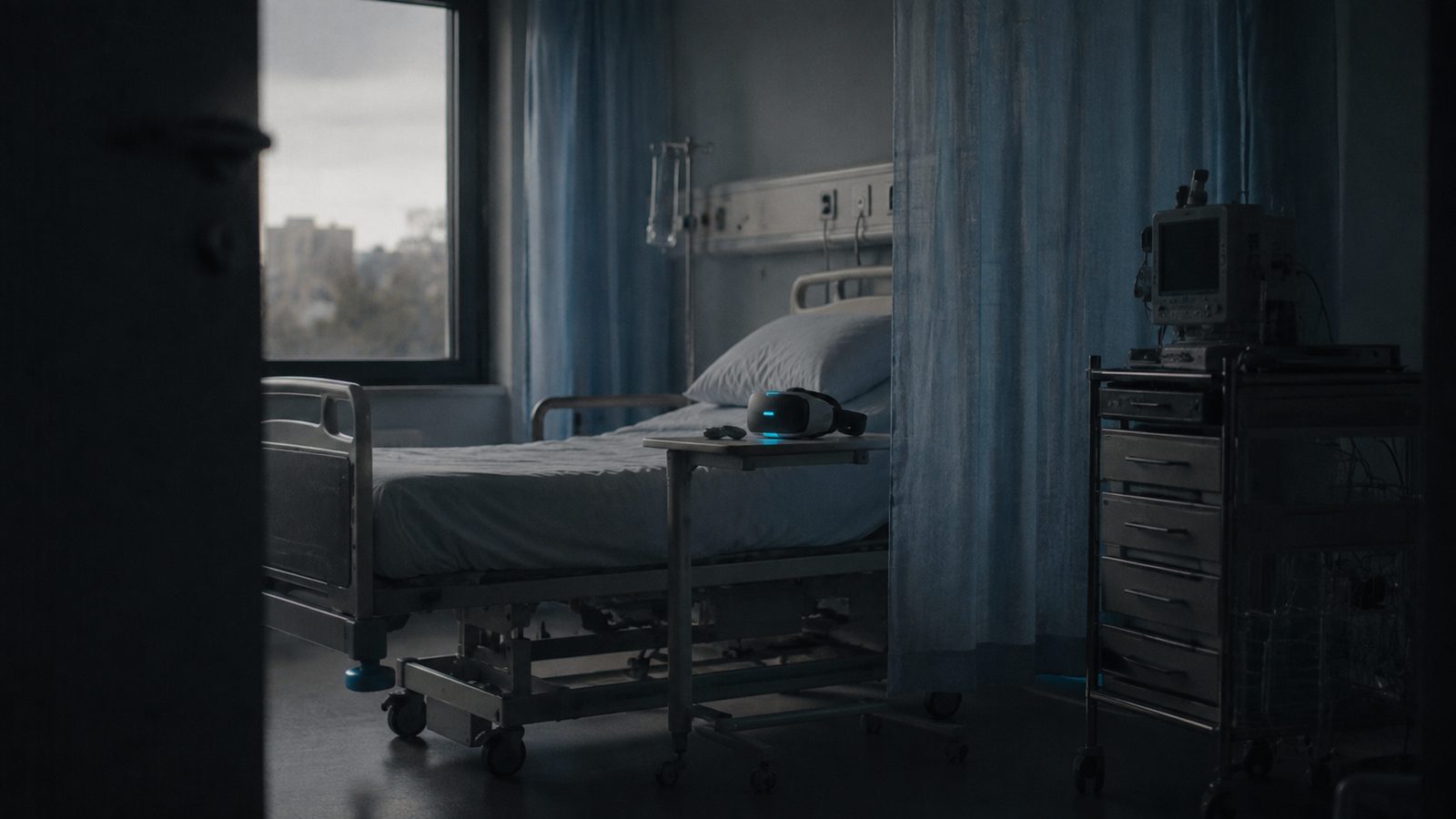
NHS trusts and health boards can now build their own VR clinical training — filmed in their own wards, aligned to their own protocols — without writing code or commissioning an agency. Cardiff and Vale University Health Board used Node XR to drill clinical staff in acute cardiac assessment, repeatedly and safely, and recorded a 94% first-time pass rate on cardiac assessment scenarios across its 2025 cohort.
Key takeaway: The scalability problem in NHS simulation isn’t the sim suite — it’s that every session needs a facilitator, a room and a rota gap. Scenario training staff can run on any ward device, with every decision auto-marked, is what removes the bottleneck.
Why simulation keeps hitting a wall in the NHS
Simulation suites work, but they don’t scale. A manikin session needs a facilitator, a room, and a rota gap — three things in permanently short supply. Off-the-shelf VR libraries promise scale, but the scenarios were filmed in someone else’s hospital, with someone else’s escalation protocol, and often someone else’s country’s terminology.
The gap is a way for clinical educators to build scenario training that matches their environment — the actual ward layout, the actual NEWS2 escalation thresholds, the actual SBAR handover culture — and update it themselves when a protocol changes.
What Cardiff and Vale built
Working with Node XR, the health board’s team built branching cardiac assessment scenarios where:
- Staff work through patient assessment, triage and SBAR handover until the sequence is automatic
- Every clinical decision branches — the wrong choice plays out its consequences rather than showing a “wrong answer” screen
- Patient point-of-view scenes build empathy alongside competence
Because scenarios run on any device — headsets, desktop browsers, phones, tablets — staff train on wards, at home, or in protected time, without booking the sim suite. Every decision, retry and score is tracked automatically, giving educators audit-ready evidence of competence (see how tracking and scoring works).
The part procurement will ask about
Immersive training in the NHS lives or dies at Information Governance review. Node XR is Cyber Essentials Plus certified, GDPR compliant, and hosted on AWS in the UK for full data residency. Learner data is encrypted at rest and in transit and is never used to train AI models — the same answers your IG team will find on our trust page.
The short answer
Can NHS teams run VR clinical training without agencies, developers or more sim-suite hours? Yes — Cardiff and Vale UHB drills acute cardiac assessment in scenarios its own educators shaped, deployed to any device staff have, with a 94% first-time pass rate and audit-ready evidence behind it. The constraint that used to gate simulation — facilitator time — is gone from the repetition step.
Build your own clinical scenarios
The same workflow applies to deteriorating-patient drills, escalation training, ward inductions and mandatory training refreshers: film your ward in 360° (or generate scenes with AI), layer branching decisions and questions on top, publish to every device, and read the results in your dashboard or LMS.
See Node XR for healthcare, the health & social care education page, or book a demo — we build a working scenario for your use case during the call.